How much should you drink during a workout, and does it need salt in it? The short answer from the American College of Sports Medicine (ACSM) and the National Athletic Trainers' Association (NATA) is that it depends on your own sweat: aim to avoid a large fluid deficit, avoid drinking more than you lose, and add sodium mainly when sessions are long, hot, or very sweaty. Neither group offers a single ounces-per-hour figure for everyone, because people differ too much for one to work.
What the two statements actually say
The ACSM position stand on exercise and fluid replacement (2007) sets out three phases. Before activity, the goal is to start "euhydrated", meaning with normal body water, by drinking with normal meals and, when needed, starting to drink at least several hours ahead so there is time to absorb it and pass the excess. During activity, the goal is to avoid a water deficit of more than about 2% of body mass and to avoid large swings in electrolytes. After activity, the goal is to replace whatever fluid and electrolytes are still missing [1].
The NATA position statement (2017) covers the same ground in more detail and puts more weight on the individual. It says sweat rate, thirst, and fluid intake during exercise all "vary greatly", that universal recommendations are "impossible", and that every active person should ideally know their own sweat rate and build a plan around it [2]. The joint statement from ACSM, the Academy of Nutrition and Dietetics and Dietitians of Canada (2016) echoes this and adds when sodium becomes worth thinking about [3].
The target is a range, not a number: finish a session having lost less than about 2% of your starting body mass, and without having gained any. Gaining mass during a session means you drank more than you sweated [2].
Why your sweat is not your training partner's
NATA's figures show how wide the spread is. Adult sweat rates during exercise run from about 0.5 to 4.0 liters per hour. Measured sodium losses range from 0.2 to 7.3 grams per hour, and sweat sodium concentration from 10 to 100 mEq/L [2]. Body size, heat, humidity, intensity, clothing and how used to the heat you are all move these numbers.
The 2016 joint statement gives a rough average for sweat sodium of about 50 mmol/L, or roughly 1 gram of sodium per liter of sweat, while stressing that it is "highly variable" [3]. To put that average in plain arithmetic: a person sweating 1 liter per hour at that concentration would lose about 1 gram of sodium in an hour. A person sweating twice as much, or with saltier sweat, could lose several times more. Someone else on the same run might lose a fraction of it.
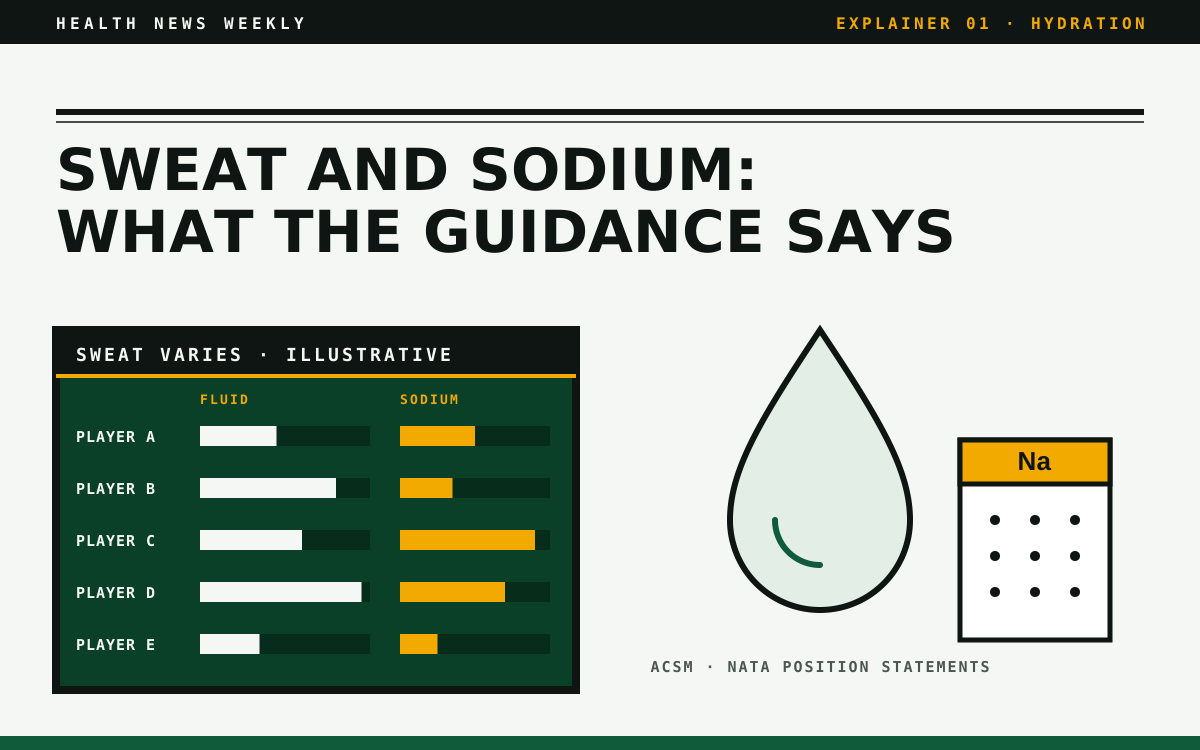
This is why the cover of this story shows five players with bars of different lengths. The bars are illustrative, but the point is real: two people doing the same session can need very different amounts of fluid and salt.
How to estimate your own sweat rate
Both statements describe the same simple method: record body mass at the start of a session and again at the end, and account for what you drank [1] [2]. The number is about fluid, not about anything else; over one session, the change on the scale is almost entirely water. NATA's equation, in its own units [2]:
Step on the scale Before
Empty your bladder, then record body mass in kilograms in minimal clothing. Use the same scale each time.
Train as usual During
Note the volume of everything you drink, in liters, and the length of the session in hours. If you need the bathroom, note that too (it is subtracted).
Step on the scale again After
Towel off, same clothing, same scale.
Do the math Anytime
Sweat loss (L) = mass before (kg) − mass after (kg) + fluid drunk (L) − urine (L). Sweat rate (L/h) = sweat loss ÷ hours of exercise.
A worked example with made-up numbers: 70.0 kg before, 69.2 kg after, 0.5 L drunk, no bathroom stop, 60 minutes. Sweat loss = 0.8 + 0.5 = 1.3 L, so the sweat rate is about 1.3 L per hour. The drop on the scale (0.8 kg) is about 1.1% of the starting 70 kg, inside the 2% range. For readers who think in pounds: each pound lost is roughly 15 fluid ounces of sweat.
One session is a snapshot. The same person will sweat more on a hot day than a cool one, so it is worth repeating the check in different weather and at different effort levels.
Too little, and too much
Most of the attention in sports marketing goes to drinking too little. The guidance takes the opposite risk just as seriously.
Too little. NATA notes that thirst typically rises at about a 2% deficit, and lists dizziness or lightheadedness, headache, nausea and general discomfort among the signs of being underhydrated [2]. The ACSM stand frames 2% as the level to stay under during activity [1]. For recreational athletes, NATA notes that the 2% threshold "has little effect" on overall exercise output and also lowers the risk from overdrinking [2].
Too much. Drinking well beyond sweat losses, whether plain water or a sports drink, can dilute blood sodium. NATA calls exercise-associated hyponatremia (low blood sodium during or after exercise) a potential medical emergency and describes it as caused by excessive intake of fluids that are less salty than blood, often in sessions of an hour or more, typically with body mass holding steady or rising during the event [2]. The 2016 statement adds that, although too little fluid is thought to be more common, the overhydration side is the more dangerous one and needs prompt medical attention [3]. Sports drinks do not remove this risk: NATA names them among the fluids, less concentrated than blood, that can cause it when drunk beyond sweat losses [2].
NATA's practical fallback: if you do not know your sweat rate, drinking to thirst during activity is "most likely" a safe way to avoid overdrinking [2].
When sodium in a drink starts to matter
For a typical 30- to 60-minute session in mild weather, ordinary meals and water are the baseline: NATA says that, as a general rule, activity lasting less than an hour should require nothing other than water [2]. Sodium becomes a live question in a narrower set of situations. The 2016 joint statement lists them as high sweat rates (above 1.2 L per hour), salty sweat, or exercise lasting longer than 2 hours [3]. The ACSM stand says drinks containing electrolytes and carbohydrate "can provide benefits over water alone under certain circumstances" [1].
NATA is more cautious still. It says people with much higher than average sweat sodium (above 60 mEq/L) and high sweat rates (above 2.5 L per hour) may benefit from sodium in their fluids, but that "no evidence indicates" a benefit from sodium beyond individual losses, and it recommends assessing sweat electrolytes before supplementing [2]. It also notes that little evidence supports the common habit of taking salt tablets to hold on to fluid [2].
That context matters when you read a drink-mix label. One stick of LMNT Citrus Salt lists 1,000 mg of sodium, which its Nutrition Facts panel shows as 43% of the Daily Value (Amazon listing images, Sep 30, 2026). The FDA Daily Value for sodium is 2,300 mg, and FDA's guide lists sodium among the nutrients to choose "less" of in everyday eating [4]. A high-sodium mix can make sense for a long, very sweaty session; it is a lot of salt to add to a normal day for no reason. Our LMNT entry, Nuun Sport entry and Skratch Labs entry put each product's sodium number next to its price.
After the session
If you finish with a real deficit and have another session soon, both NATA and the 2016 statement describe drinking more than you lost, because some of it will pass through as urine: NATA gives 100% to 150% of the fluid deficit when recovery time is under about 4 hours, and the 2016 statement gives 125% to 150%, or roughly 1.25 to 1.5 L for every 1 kg drop on the scale [2] [3]. The 2016 statement also says people should not be told to restrict sodium in their post-exercise meal when they have lost a lot of it [3]. For most people with a day between workouts, regular meals and drinks handle this without any plan at all.
- Know roughly how much you sweat in hot and cool weather (the scale method above).
- Check that you are not finishing sessions heavier than you started.
- Save sodium-heavy drinks for long, hot, or very sweaty sessions.
- Read sodium per serving, and servings per bottle, on any drink mix.
- Carry a bottle you will actually refill; see our Nalgene and Hydro Flask entries.
If a clinician has told you to limit sodium or fluid, or you take medication that affects fluid or blood pressure, ask them before using high-sodium drink mixes or changing how much you drink. NATA advises that active people with chronic medical conditions consult their own physicians about hydration [2]. Confusion, severe headache, vomiting or swelling during or after long exercise needs urgent medical care, not more fluid. This explainer summarizes published guidance for healthy adults; it is not a personal hydration plan.
Sources
- American College of Sports Medicine. Position stand on exercise and fluid replacement. Medicine & Science in Sports & Exercise, 2007;39(2):377–390. PMID 17277604. PubMed
- National Athletic Trainers' Association. Position statement on fluid replacement for the physically active. Journal of Athletic Training, 2017;52(9):877–895. PMID 28985128. Full text (PMC)
- American College of Sports Medicine, Academy of Nutrition and Dietetics, Dietitians of Canada. Joint position statement on nutrition for athletes. Medicine & Science in Sports & Exercise, 2016;48(3):543–568. PMID 26891166. PubMed; full text as published by Dietitians of Canada: PDF
- U.S. Food and Drug Administration. How to Understand and Use the Nutrition Facts Label. fda.gov
This article is educational and is not medical advice. Ask a qualified clinician before changing how you eat, drink or supplement around exercise, especially if you have an existing condition or take medication.