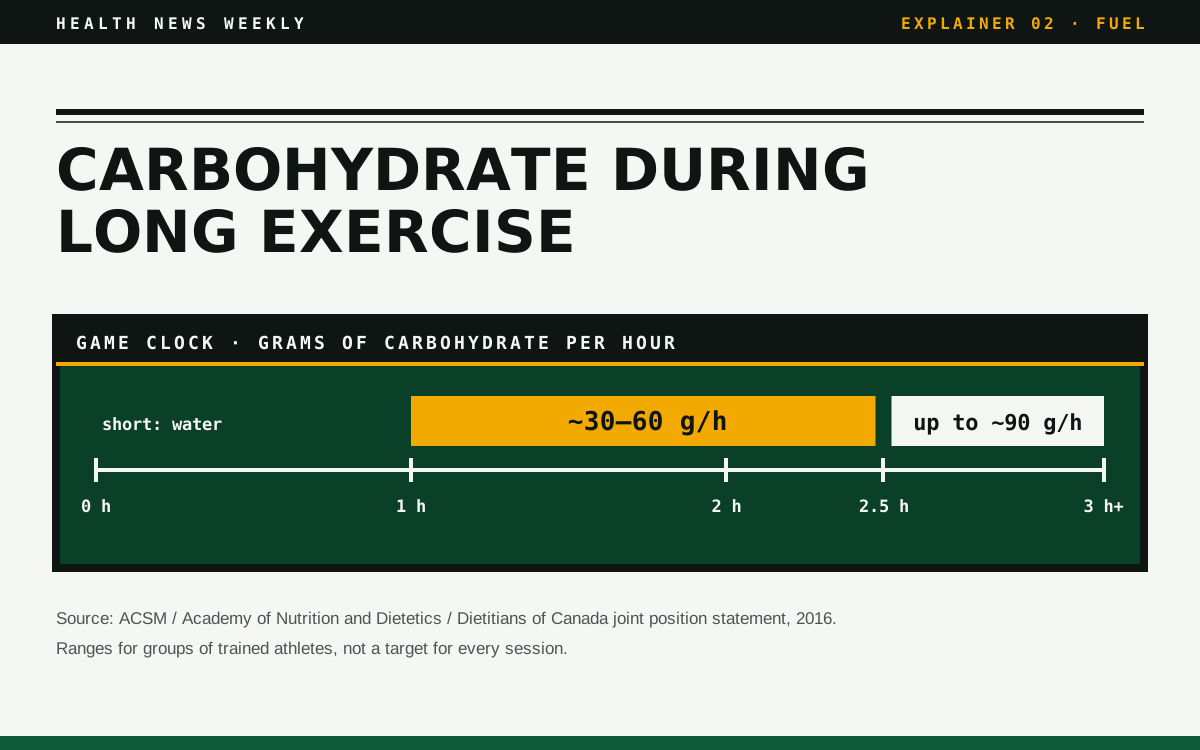
Do you need to eat or drink carbohydrate while you exercise? For sessions under about 45 minutes, the main joint guidance says no; for sessions of roughly 1 to 2.5 hours it suggests about 30 to 60 grams per hour, and for sessions past about 2.5 to 3 hours, up to about 90 grams per hour. Those ranges come from a 2016 joint position statement by the American College of Sports Medicine, the Academy of Nutrition and Dietetics and Dietitians of Canada, and they rest mostly on research in trained athletes working hard [1].
The table the numbers come from
The 2016 joint statement includes a table of carbohydrate targets by situation. The during-exercise rows read as follows, with the row labels lightly paraphrased and the numbers unchanged [1]:
| Session | Length | Carbohydrate during |
|---|---|---|
| Brief exercise | < 45 min | Not needed |
| Sustained high-intensity exercise | 45–75 min | Small amounts, including mouth rinse |
| Long exercise, including stop-and-start sports | 1–2.5 h | 30–60 g per hour |
| Ultra-distance exercise | > 2.5–3 h | Up to 90 g per hour |
Our cover simplifies the first two rows to "short: water". The fuller wording is worth knowing: for hard efforts of 45 to 75 minutes, the statement describes frequent contact of small amounts of carbohydrate with the mouth, even a rinse, as having an effect through the brain and nervous system rather than as fuel for the muscles [1]. For an easy 40-minute jog, nothing in the table suggests you need anything but water.
The International Society of Sports Nutrition (ISSN) lands in the same place. Its 2017 position stand on nutrient timing suggests about 30 to 60 grams of carbohydrate per hour for sessions of more than 60 minutes at high intensity, taken as a 6–8% carbohydrate-electrolyte drink, 6 to 12 fluid ounces every 10 to 15 minutes [3]. Its 2018 review update repeats that range for hard sessions lasting beyond 90 minutes [4].
These are ranges for long, hard sessions. They are not a daily quota and not a reason to eat a chew every mile of a 5K.
Why 60, and why 90
The ceilings come from absorption. A 2014 review in Sports Medicine on personalizing carbohydrate intake during exercise explains that glucose is absorbed through a transporter in the gut that becomes saturated at roughly 60 grams per hour. For years that was treated as the limit for all carbohydrate [2]. Studies then showed that adding a second sugar that uses a different transporter, typically fructose alongside glucose or maltodextrin, allowed more carbohydrate to be used per hour. That is where the higher figure for very long events comes from, and why the review says intakes that high need to be "multiple transportable carbohydrates" [2]. The 2016 statement makes the same point about glucose–fructose mixtures [1].
What the research measured is also worth stating plainly. The 2016 statement says higher intakes in events beyond about 2.5 hours "are associated with better" results, and the review cites trials in trained cyclists [1] [2]. Those are findings in fit people doing long, demanding work under study conditions. They do not tell you what a recreational rider on a flat 90-minute loop will notice.
Who the ranges were written for
The review is direct about this. It describes its recommendations as being "for well trained athletes" and says that less experienced ("aspiring") athletes "may need to adjust these recommendations downwards" [2]. It adds that the right amount depends on absolute exercise intensity: its example is that a runner finishing a marathon in 5 hours would not necessarily need 90 grams per hour, because that could approach or exceed the total carbohydrate that person burns at that pace [2].
Three practical consequences for a normal week:
- Length matters first. Most gym sessions, 5Ks and 45-minute rides sit in the "not needed" row.
- Intensity matters second. An easy 2-hour hike burns carbohydrate far more slowly than a 2-hour race.
- The top of each range is a ceiling for trained people working hard, not a target to hit.
Reading chews, waffles and drink mixes against the ranges
This is where the label does the work. Look for "Total Carbohydrate" per serving, then check what a serving is. Two examples, read from the Nutrition Facts panels on the Amazon listing (Honey Stinger) and the brand's product page (Skratch Labs) on Sep 30, 2026:
| Product (flavor) | Serving | Carbs / serving | Servings for 30 g | Servings for 60 g |
|---|---|---|---|---|
| Honey Stinger Organic Waffle (Honey) | 1 waffle (30 g) | 19 g | ~1.5 | ~3 |
| Skratch Labs Hydration Sport Drink Mix (Lemon Lime) | 1 scoop (22 g) | 20 g | 1.5 | 3 |
The division is ours, and it is just arithmetic. Carbohydrate chews vary by flavor and brand, so read the packet; our Clif Bloks entry lists the label numbers for the flavors in its variety box. Low-sugar electrolyte tablets and zero-sugar mixes such as Nuun Sport and LMNT are built for electrolytes and carry little or no carbohydrate, so they do not count toward these ranges. Ordinary food works too: the 2016 statement notes that everyday foods and drinks as well as sports products can supply carbohydrate during exercise, from liquid to solid [1].
A sample timeline for a long, hard session of about two hours, using only the published guidance:
Pre-session meal 1–4 h before
The 2016 table suggests 1–4 g of carbohydrate per kg of body mass, eaten 1–4 hours before sessions longer than 60 minutes, and notes that choices high in fat, protein or fiber may need to be avoided close to the start to reduce stomach trouble [1]. A fiber-rich bowl of rolled oats fits better at the early end of that window.
Small, regular sips or bites Every 10–15 min
The ISSN pairs its figure of about 30 to 60 g per hour with 6 to 12 fl oz of a 6–8% carbohydrate drink every 10 to 15 minutes [3]. Those volume ranges are wide (the strongest drink at the largest, most frequent sip would land well above 60 g an hour), so use the grams-per-hour figure as the anchor and size the sips to fit it. Chews or a waffle with water are an alternative.
Stay inside what you practiced Throughout
The 2016 statement says athletes should practice to find a plan that suits their goals, hydration needs and gut comfort [1]. The review notes anecdotal evidence that the gut can be trained to handle more [2]. Race day is not the day to try 90 g per hour for the first time.
Concentration: the number most people skip
Grams per hour is only half of a drink. The other half is how much water those grams are dissolved in. The ISSN's 2018 review describes the commonly advised strength as a 6–8% solution, which it defines as 6 to 8 grams of carbohydrate per 100 mL of fluid [4]. Much stronger than that and a drink is closer to syrup; much weaker and you would need a lot of fluid to reach the hourly range.
The arithmetic is simple enough to do at the kitchen counter. One Skratch Lemon Lime scoop lists 20 g of carbohydrate. Dissolved in 16 fl oz (about 473 mL), that is about 4.2 g per 100 mL, or roughly 4%. The same scoop in 12 fl oz (about 355 mL) is about 5.6%. Follow the mixing directions on the pouch you buy, but it helps to know which way the numbers move: less water means a stronger drink, and a stronger drink is more likely to sit heavily for some people.
A few other label habits help:
- Read "Total Carbohydrate", not just "Total Sugars". Maltodextrin and other starches count toward carbohydrate but not toward sugars.
- Check servings per container and per packet. A single wrapper or stick can hold more than one serving.
- Check for caffeine. Some chews and gels carry it, and it varies by flavor; see our caffeine explainer.
- For the full walkthrough of a panel, see How to Read a Sports-Nutrition Label.
If you have a condition that affects how your body handles sugar, take medication that affects blood sugar, or have a sensitive stomach, talk to a clinician or registered dietitian before adding sports carbohydrate to your sessions. These ranges describe research in healthy, trained adults; they are not individual advice, and more is not automatically better.
Sources
- American College of Sports Medicine, Academy of Nutrition and Dietetics, Dietitians of Canada. Joint position statement on nutrition for athletes. Medicine & Science in Sports & Exercise, 2016;48(3):543–568. PMID 26891166. PubMed; full text as published by Dietitians of Canada: PDF
- Review on personalized carbohydrate intake during exercise. Sports Medicine, 2014;44(Suppl 1):S25–S33. PMID 24791914. Full text (PMC)
- International Society of Sports Nutrition. Position stand on nutrient timing. Journal of the International Society of Sports Nutrition, 2017;14:33. PMID 28919842. Full text (PMC)
- International Society of Sports Nutrition. Exercise and sports nutrition review update: research and recommendations. Journal of the International Society of Sports Nutrition, 2018;15:38. PMID 30068354. Full text (PMC)
This article is educational and is not medical advice. Ask a qualified clinician before changing how you eat, drink or supplement around exercise, especially if you have an existing condition or take medication.