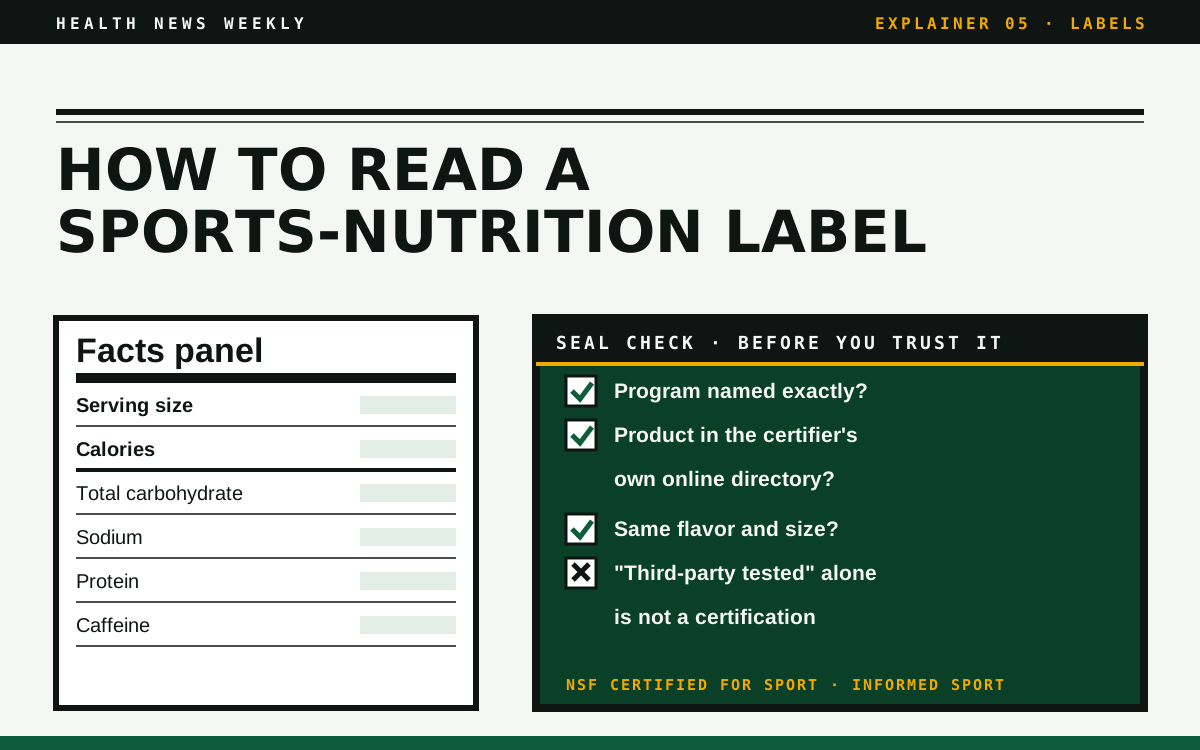
How do you read the label on a drink mix, chew or protein powder? Start by noticing whether it carries a Nutrition Facts panel or a Supplement Facts panel, then read the serving size before any other number, because every figure below it depends on it. If the pack shows a sport certification, check that it names a real program and that the exact product appears in that program's own online directory; phrases like "third-party tested" are not certifications.
Nutrition Facts or Supplement Facts?
Sports products sit on both sides of a regulatory line. Foods and drinks carry a Nutrition Facts panel; dietary supplements carry a Supplement Facts panel. The panel title tells you which category the maker chose, so read it rather than inferring it from the product type.
The FDA's Dietary Supplement Labeling Guide lists the main differences [2]:
- A Supplement Facts panel must list dietary ingredients that have no Daily Value (a botanical extract, for example); a Nutrition Facts panel is not allowed to.
- A Supplement Facts panel may name the source of an ingredient and must name the part of the plant used; a Nutrition Facts panel may not.
- A Supplement Facts panel may not list nutrients at zero; a Nutrition Facts panel must list required nutrients even when the amount is zero.
That last point matters in practice. On a Nutrition Facts panel, required nutrients appear even at zero, so "0 g" is an explicit declaration. On a Supplement Facts panel, a nutrient at zero is simply left off. Both drink mixes we read for this site, LMNT Citrus Salt and Skratch Labs Lemon Lime, show a Nutrition Facts panel in their Amazon listing images (Sep 30, 2026).
Serving size first
The FDA's guide to the Nutrition Facts label starts with the same instruction: look at servings per container and the serving size first [1]. It explains that serving sizes reflect the amount people typically eat or drink, that they are "not a recommendation" of how much you should have, and that every amount on the label, calories included, refers to that serving [1].
Sports products make this easy to get wrong. A stick, a tube, a scoop, a packet of chews and a bottle can each be one serving or several. Check the line, then do the multiplication for what you actually use.
The Nutrition Facts image on the Skratch Labs Lemon Lime 20-serving pouch listing we checked shows "60 servings per container" and 380 mg of sodium per scoop: apparently an older panel from a larger bag. The current 20-serving bag panel on Skratch's own product page reads 400 mg per 22 g scoop, which matches the "400 mg sodium per serving" graphic on the same listing. The per-scoop numbers are the useful part, and a listing image can lag behind the pack. When images disagree, trust the panel printed on the pack you actually receive.
% Daily Value, and the numbers that matter for sport
The % Daily Value (%DV) column shows how much one serving contributes to a day's intake, based on a 2,000-calorie reference diet. The FDA's rule of thumb: 5% DV or less per serving is low, 20% DV or more is high [1]. The Daily Value for sodium is 2,300 mg, and FDA lists sodium, saturated fat and added sugars as nutrients to choose lower %DVs of more often [1].
Applied to two drink mixes: one LMNT Citrus Salt stick lists 1,000 mg of sodium, shown as 43% DV; one Skratch Lemon Lime scoop lists 400 mg, shown as 17% DV (LMNT: Amazon listing image; Skratch: the 20-serving bag panel on the brand's page; both Sep 30, 2026). One is high by FDA's rule, the other is just under the line. Neither number is good or bad by itself; it depends on the session, as our sweat and sodium explainer sets out.
For active people, a few lines usually carry the story:
- Total carbohydrate, for fuel during long sessions. Our carbohydrate explainer puts it against grams-per-hour ranges.
- Total and added sugars, which are part of carbohydrate but not all of it.
- Sodium (and potassium), for electrolyte mixes.
- Protein, for shakes and powders, read per serving, not per container.
- Caffeine, which is not a required line; see below.
Caffeine and "proprietary blends"
Caffeine is not a standard line on either panel. The FDA says packaged foods must list caffeine in the ingredient list when it is added on its own, that caffeine from an ingredient that naturally contains it (chocolate, for example) need not be named, and that many products show the milligrams voluntarily [5]. Look for the word "caffeine" or an ingredient such as green tea extract, and for a milligram figure on the front. Our caffeine explainer covers how to add it up.
A "proprietary blend" on a Supplement Facts panel follows specific rules. According to the FDA guide, the blend must be identified as such (or given a descriptive or fanciful name), the total weight of the blend's ingredients must appear on the same line, and the ingredients must be listed beneath it in descending order by weight [2]. Nutrients that have Daily Values must still be listed separately with their amounts, but the individual amounts of the other ingredients inside the blend do not have to be given [2]. In plain terms: you learn what is in the blend and its total weight, not how much of each ingredient you are getting.
Sport certification seals: what they test
Dietary supplements are not evaluated by the FDA before they are sold. The U.S. Anti-Doping Agency (USADA) puts it this way on its Supplement Connect page, and says that people who choose to use supplements can reduce their risk by using third-party certified products; USADA says it currently recognizes NSF Certified for Sport as the program best suited for athletes [6]. The two sport programs you are most likely to see on a US shelf are:
| Program | What the program says it checks | Where to look it up |
|---|---|---|
| NSF Certified for Sport | That products do not contain any of 290 substances banned by major athletic organizations; that contents match the label; that there are no unsafe levels of contaminants; and that the product is made in a GMP-certified facility audited by NSF [3]. | nsfsport.com certified-products search, by name, keyword or lot number |
| Informed Sport | That every batch is tested before release for more than 285 substances prohibited in sport, using ISO 17025 accredited methods, after a review of the product and manufacturing quality systems [4]. | sport.wetestyoutrust.com supplement search, by brand, product or type |
Names matter, because each organization runs more than one program. Informed Choice is a sister program of Informed Sport; its own site describes it as a retail-monitoring and quality-assurance program, whereas Informed Sport tests every batch before release [4]. NSF also certifies supplements under standards other than Certified for Sport [3]. On this site we credit a seal only when the exact program name appears on the listing or brand page and the product appears in that certifier's directory on the day we checked.
Some phrases look like seals and are not. "Third-party tested", "lab tested" and "made in a GMP facility" describe processes a company says it follows; none of them names a program you can look up. Informed Sport goes further, noting that a label reading "Safe for Sports People" or "Approved by WADA" is meaningless because anti-doping bodies do not approve supplement products [4]. USADA has also published an advisory urging athletes to always verify third-party certified logos [6].
Checking a seal yourself
The check takes a couple of minutes, and the order matters:
Read the exact program name On the pack
"NSF Certified for Sport" and "Informed Sport" are specific. A generic checkmark, "tested", or a certifier's name without the program is not the same thing.
Search the certifier's own directory Online
Use nsfsport.com or sport.wetestyoutrust.com directly, not a link or badge on a seller's page.
Match flavor and size In the listing
Certification can be product-specific. Informed Sport notes that under its program every flavor and variation is tested [4], which is also why a listing for one flavor does not automatically cover another.
Check the batch if you compete Before use
Informed Sport lets you confirm that a specific batch was tested [4]; NSF's directory can be searched by lot number [3]. Athletes in tested sports should also check USADA's resources [6].
A seal is about contents and contamination, not about whether a product suits you. If you have a medical condition, take medication, are pregnant, or have been told to limit sodium, sugar, caffeine or protein, ask a clinician which lines on the label matter for you. Athletes subject to drug testing are responsible for what they take, certified or not.
Sources
- U.S. Food and Drug Administration. How to Understand and Use the Nutrition Facts Label. fda.gov
- U.S. Food and Drug Administration. Dietary Supplement Labeling Guide (2005), including Chapter IV, Nutrition Labeling. Guide; Chapter IV
- NSF. Certified for Sport: program home and "What Our Mark Means". nsfsport.com; What our mark means
- Informed Sport (LGC). Program home, certification process, and Informed Sport vs Informed Choice. sport.wetestyoutrust.com; Certification process; Sport vs Choice
- U.S. Food and Drug Administration. Spilling the Beans: How Much Caffeine Is Too Much? fda.gov
- U.S. Anti-Doping Agency. Supplement Connect. usada.org
This article is educational and is not medical advice. Ask a qualified clinician before changing how you eat, drink or supplement around exercise, especially if you have an existing condition or take medication.