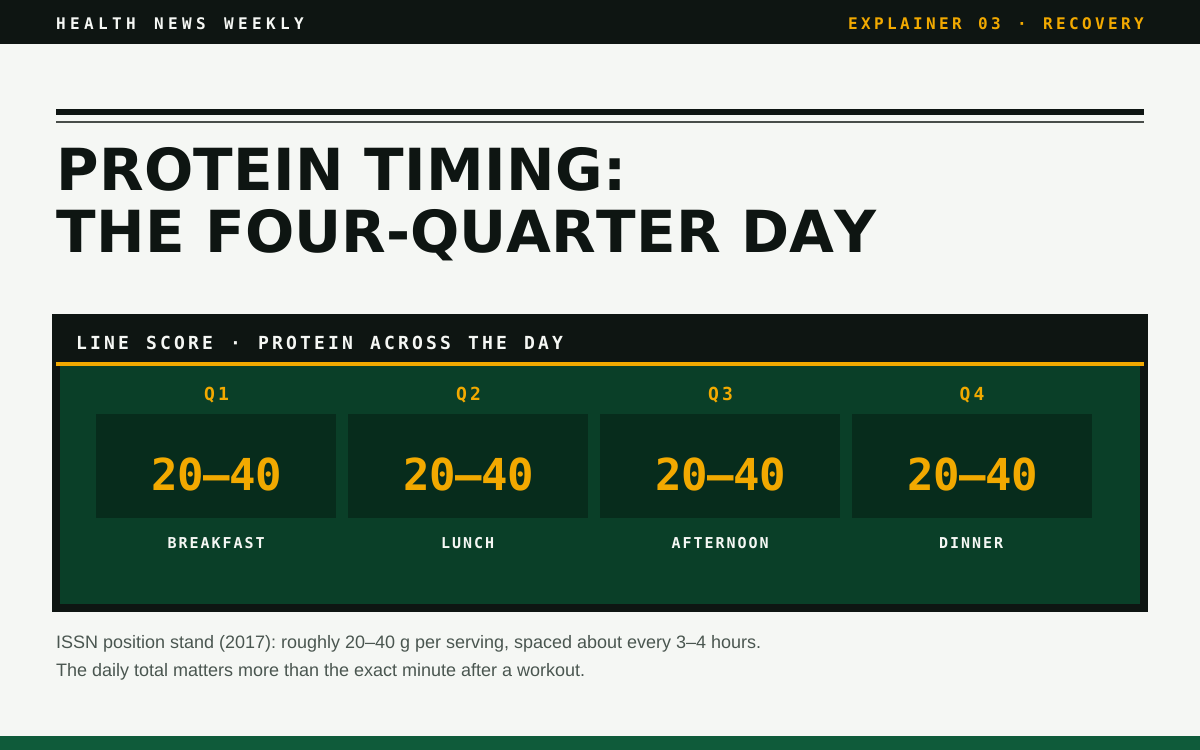
Does it matter when you eat protein after exercise? Less than the marketing suggests: the reviews we read agree that your total protein for the day matters most, and the International Society of Sports Nutrition (ISSN) suggests spreading it into servings of roughly 20 to 40 grams every 3 to 4 hours. Eating protein near a workout is reasonable, but a shake in the locker room is a convenience, not a requirement.
Where the "window" idea came from
The logic is easy to follow. Exercise, especially resistance exercise, and eating protein both switch on muscle protein synthesis, the process of building and repairing muscle proteins, and the ISSN describes the two as working together when protein is eaten before or after training [1]. From there it is a short step to a rule: if protein and exercise work together, surely the closer together the better, and perhaps there is a narrow window, often quoted as 30 to 60 minutes, that you miss at your peril.
The trouble is that short-term lab measurements of protein synthesis do not automatically translate into what happens over weeks of training. A 2013 meta-analysis on protein timing, published in the Journal of the International Society of Sports Nutrition, set out to check whether the timing rule held up in longer training studies. Its introduction describes the results of those studies as "decidedly mixed" [3].
What the 2013 meta-analysis found
The analysis pooled randomized controlled trials in which one group took protein close to a resistance-training session and a comparison group did not. It looked at two outcomes, muscle strength and muscle size. The strength analysis covered 478 participants in 20 studies; the muscle-size analysis covered 525 participants in 23 studies [3].
- Simple pooling: timed protein showed a small-to-moderate effect on muscle size and no significant effect on strength.
- After adjusting for other factors: no significant difference between timed and untimed groups for either outcome.
- The biggest driver: for muscle size, total protein intake was the strongest predictor of the effect. The paper reports that apparent timing benefits were confounded by differences in how much protein the groups ate.
The authors concluded that their results contradicted the common belief that protein timing around a session is critical, and that eating enough protein alongside resistance training is the key factor [3].
It is fair to note the limits, as the paper itself does. Most of the included trials were in people new to resistance training; only four used trained participants. Only a small number matched total protein between groups, which the authors say limits firm conclusions about timing on its own. And the comparison groups ate at very different times, some within two hours of training and some many hours later [3]. The meta-analysis does not show that timing is irrelevant in every situation; it shows that the evidence for a strict window is weak once total intake is accounted for.
Hit a sensible daily total first. Spacing it into a few real servings comes second. The exact minute after a workout comes a distant third.
What the ISSN and the 2016 joint statement say
The ISSN published two position stands in 2017 that touch on this. The protein stand says an overall intake of 1.4 to 2.0 g of protein per kg of body mass per day is sufficient for most exercising individuals; that a general per-serving target is about 0.25 g per kg, or an absolute dose of 20 to 40 g; and that these doses should ideally be spread evenly, every 3 to 4 hours, across the day [1]. On timing, it says the best time to take protein "is likely a matter of individual tolerance", because benefits have been seen with protein before or after a workout, and that the effect of exercise lasts at least 24 hours while probably fading as time passes [1].
The nutrient-timing stand puts meeting total daily protein, "preferably with evenly spaced protein feedings", as a primary area of emphasis, and describes 20 to 40 g servings every three to four hours as the pattern that appears most favorable for muscle protein synthesis rates in the research it reviewed [2].
The nutrient-timing stand also makes a practical point that deflates much of the post-workout rush: the size and timing of your pre-exercise meal may affect how much a post-exercise protein serving is needed at all [2]. Someone who ate a protein-containing lunch two hours before an afternoon session is in a different position from someone who trains fasted first thing in the morning. Read plainly, the stand suggests the post-session serving carries more weight for the second person than for the first.
The 2016 joint position statement from the American College of Sports Medicine, the Academy of Nutrition and Dietetics and Dietitians of Canada gives a slightly different daily range, 1.2 to 2.0 g per kg, and expresses servings as about 0.3 g per kg after key sessions and every 3 to 5 hours over multiple meals. It adds that such intakes "can generally be met from food sources" [4]. It is also more positive about timing than the meta-analysis: it says longitudinal training studies "currently suggest" the largest strength and muscle changes come with protein given immediately after exercise [4]. The groups agree on the big picture and differ on how much weight to put on the post-workout slot.
A four-quarter day, in plain numbers
To turn the ranges into a day, take a person with a body mass of 70 kg. The ISSN's 1.4 to 2.0 g per kg works out to about 98 to 140 g of protein a day, and its 0.25 g per kg per serving works out to about 18 g, so the absolute 20 to 40 g range is the easier number to use. Four servings in that range would supply about 80 to 160 g. Our arithmetic, not a prescription; needs differ with body size, training and diet.
First quarter Breakfast
A serving in the 20–40 g range.
Second quarter Lunch
Another 20–40 g, about 3 to 4 hours later.
Third quarter Afternoon or after training
If you train in the afternoon or evening, this is the natural place for a post-session serving. Food works; so does a shake if that is what is practical.
Fourth quarter Dinner
A final 20–40 g. If the day's total is already met, there is nothing to chase.
Where a shake or powder fits
Nothing in these statements requires a protein product. The ISSN protein stand describes supplements as "a practical way" to ensure protein quality and quantity, while noting that active people can meet their needs from whole foods [1]. A shake is useful when you are away from a kitchen, short on time, or find it hard to fit protein into a particular meal.
For reference, per the product listings on Amazon on Sep 30, 2026: a Premier Protein shake lists 30 g of protein per 11.5 fl oz bottle, a Fairlife Core Power shake lists 26 g per 14 fl oz bottle, and a scoop of Optimum Nutrition Gold Standard Whey lists 24 g. Each sits inside the 20 to 40 g range for a single serving. Our entries compare what each costs per serving and what else is on the label, including the milk allergen they all share.
- Check the grams of protein per serving, not per container.
- Check the serving size: one scoop, one bottle, or half a bottle.
- Check allergens (milk, soy) and sweeteners if they matter to you.
- Compare cost per serving against an ordinary protein food you already eat.
If a clinician has told you to limit protein, or you have a condition affecting how your body processes it, ask before raising your intake or adding shakes. The same applies if you have a milk allergy or are pregnant. These figures come from reviews of research in healthy, exercising adults and are not individual targets.
Sources
- International Society of Sports Nutrition. Position stand on protein and exercise. Journal of the International Society of Sports Nutrition, 2017;14:20. PMID 28642676. Full text (PMC)
- International Society of Sports Nutrition. Position stand on nutrient timing. Journal of the International Society of Sports Nutrition, 2017;14:33. PMID 28919842. Full text (PMC)
- Meta-analysis of protein timing and changes in muscle strength and size. Journal of the International Society of Sports Nutrition, 2013;10(1):53. PMID 24299050. PubMed; full text (PMC)
- American College of Sports Medicine, Academy of Nutrition and Dietetics, Dietitians of Canada. Joint position statement on nutrition for athletes. Medicine & Science in Sports & Exercise, 2016;48(3):543–568. PMID 26891166. PubMed; full text as published by Dietitians of Canada: PDF
This article is educational and is not medical advice. Ask a qualified clinician before changing how you eat, drink or supplement around exercise, especially if you have an existing condition or take medication.